Source:Li Lu’s interview at Columbia
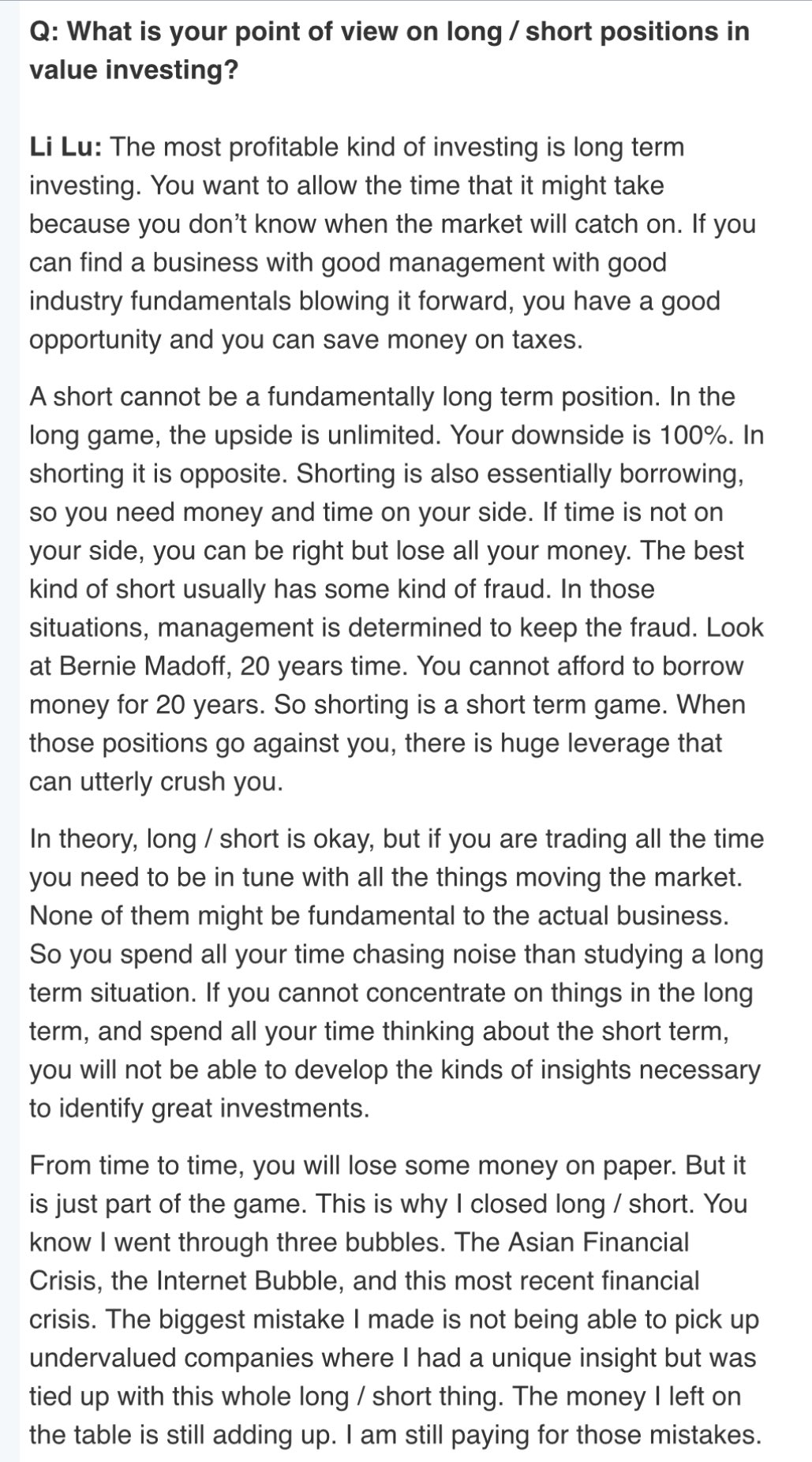
Source:Li Lu’s interview at Columbia
Although primary markets have witnessed initial public offerings(IPOs) worth more than `10,000 crore during CY16, the larger portion of money raised during the year has found its way to existing shareholders.
According to data compiled from National Stock Exchange (NSE), of the `10,740 crore raised during the year via initial share sales, around `5,978 crore was mopped by promoters and private equity (PE) players who sold stakes. The remaining `4,763 crore will be used by companies either to pare debt or as growth capital.
The PE players who pared their holding through IPOs during 2016 include Sequoia Capital, Gaja Capital, Helion Venture Partners, Sarva Capital and Gaja Capital.
The initial share sale of both Mahanagar Gas and L&T Infotech was completely offer for sale(OFS). While Mahanagar Gas raised `1,039.63 crore via IPO, L&T Infotech garnered `1,260 crore, data showed.
Equitas Holdings the biggest IPO during 2016 so far also had a substantial OFS component. The company raised `2,176 crore of which `1,456 crore was on account of complete exits made by six PE players including Sequoia Capital, WestBridge Ventures and Aquarius Investments.
The IPO of Advanced Enzyme, which will hit markets during next week, is also largely an OFS. Out of the `411 crore the company is planning to raise, `361.48 crore is on account of exit by various existing shareholders including Kotak Private Equity.
The trend is also evident in the upcoming IPOs. For instance, ICICI Prudential — insurance arm of India’s largest private bank ICICI Bank —which is planning to launch its IPO by the end of 2016 is a complete OFS. ICICI Bank is planning to sell 10% of its stake in the insurer to fetch more than `5,000 crore-from FE
I also do know that India now has the best digital infrastructure for financial inclusion or financial universalisation and the fact that we have the Jan-Dhan, Aadhaar and Mobile (JAM) layer, we have Indian stack that allows you to paperless, presence-less and cashless transactions.
The fact that India is going to go from being data poor to data rich, which allows lending to be based on data, will actually make it safer.
All these are incredibly powerful things that didn’t exist earlier and we have the perfect trifecta because India is going to grow.
So let’s say GDP plus interest rate, nominal GDP growth at 12-13 percent, credit is going to deepen because more people will get loans, so lets say that institute to 20 percent and then the fact that the PSU bank lending is going to be muted for whatever issues they have NPAs, lack of capital and so on.
So a good private sector lender whether it’s a bank or NBFC, I see no reason why they can’t grow at 30 percent compounded for the next several years simply because of the market situation.-said Nandan Nilekani
I am very glad we only do India and that we are doing India now.
I don’t know how a global investor gets out of bed in the morning. You would be looking forward to what, exactly? Perhaps a “comforting” comment by some central banker?
We get out of bed and have the strongest GDP (gross domestic product) growth in the world, an Econ 101 slowdown ending and—we assume—an economy starting to accelerate, and some of the best-managed companies in the world with very little debt.
To the extent that any investor knows and/ or understands these things, then they will allocate to India. And vice versa.
I assume that increasingly they will become comparatively aware of this new India and, therefore, absolutely convinced they should buy it. How can they come to the opposite conclusion?
If (Federal Reserve chief Janet) Yellen, (European Central Bank president) Draghi and (Bank of Japan governor Haruhiko) Kuroda were to promise liquidity forever, then maybe that is as exciting.
Otherwise, I look forward to tomorrow morning and assuming, God willing, that I can get out of bed, then I know that growth and profits will be on the breakfast table, rather than the rash promise of a failed liquidity continuity.
No contest.
-said Jon Thorn of India Capital Fund Management
(Disclosure:I am market making in the shares of Tata Technologies)
Tata Technologies, Tata Advanced Materials and TAL Manufacturing Solutions Ltd have announced a new collaboration at the Farnborough International Air Show.
The three Tata group companies have agreed to come together to offer an end to end Design, Manufacturing and Assembly capability to the aerospace manufacturing industry.
It will include a strong focus on outsourced manufacturing for both metallic and composites and a strong capability in the design and engineering domains supported with a holistic capability in product lifecycle management integration.
“The industry is looking for quality, cost and capability as it strives to meet the unprecedented demand for higher productivity across the supply chain,” said Warren Harris, Tata Technologies managing director and CEO.
He continued: “Tata’s strength lies in a decade of significant investment in cutting edge next generation manufacturing facilities in India and a strong leadership position at Tata Technologies in advanced design and manufacturing engineering capabilities.”-from Engineering Capacity