Categories
Excerpts

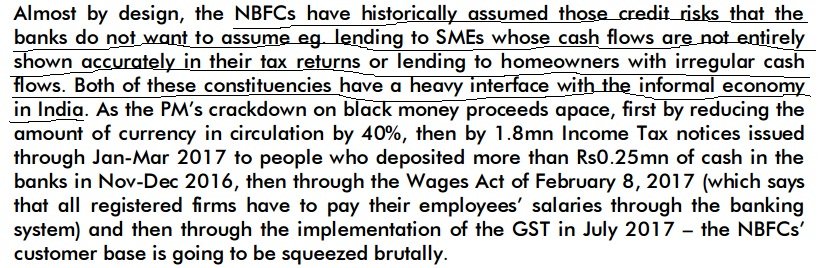
NBFCs headed for a fall?

Source: Ambit Research Report

Hat Tip: Aveek Mitra

Categories
Excerpts

Narayan Murthy should shut up

Narayan Murthy is making a mountain out of mole.

If we compare the hike in salary of Praveen Rao with the industry peers, it is not very high.

So, I do not think he is making any valid point. To say now that we always took very low salaries and all that is all humbug.

Those were the different days and he had huge amount of shares in the company. So it suited them to not to debit profit and loss account with high salaries.

But things have changed, Praveen is not a founder, Praveen is a professional who is being paid based on his professional competencies and what peer compensation packages would be.

This is a very uncalled for debate and mudslinging which Mr Murthy has unnecessarily got himself entangled in.

I am pained actually to see his email.

He has used I, me and myself 23 times.

Is this becoming of a leadership that you keep on talking about? I did this, I did that, it was me, it was my decision, what is it? Where are we on this?

You have done your good job, you are leaving legacy behind. Leave it and go ahead in life and look at many more things than engaging yourself into Praveen’s salary. Why does he go on saying we do not like this kind of salary to be paid?

Leave it to Vishal Sikka, leave it to Seshasayee, leave it to the company. They will decide what has to be done.

You have done your job for almost close to 30 years, you came back, you were there for one year, you again went back, you again engaged.

In February you called truce and said “I will not go into public and talk about it, if there is any differences we will settle within”.

Then what happens?

Just Praveen’s salary has become a big issue for you to write a huge mail to the media and saying that I am not approving it.

This is completely, highly unbecoming of a leader like Mr Narayana Murthy. I hope and pray wisdom will prevail and he will not again engage into these kind of things-said Anil Singhvi

Categories
Excerpts Quotes

Promoter Capture

Source: Ambit Capital Sivasubramanian’s Address

Categories
Excerpts

Howard Marks meets the Indian Consensus

Source: Debashis Basu

Categories
Excerpts

The Moat Dilemma

Hat Tip: Niraj Bardia

Source: Robert Vinall, R V Capital,Annual Letter to Investors

A key tenet of value investing is competitive advantage. The idea behind competitive advantage is that businesses need to be protected by barriers to entry to earn a return on capital above their cost of capital. Warren Buffett coined the term “moat” to describe this. Examples of moats are brands, switching costs and network effects.

The dilemma facing value investors today is that whilst moat continues to be a prerequisite to earning excess returns on capital, it no longer seems sufficient. The pace of change is too fast.

There is scarcely a single sector that either has not been disrupted already or might plausibly be disrupted soon. The disruption of newspapers by the Internet or taxi services by Uber are well known examples of the former. The threat to car insurers from self-driving cars is just one example of the latter. No company is safe.

The pace of change leaves value investors feeling increasingly disorientated. They traditionally spurn sectors that are subject to fast change such as biotech, fashion or technology, preferring to focus on sectors which are predictable and subject to slow,incremental change.

However, what is to be done if the universe of unchanging businesses is continually shrinking and, moreover, all the economic growth, and hence value creation, is coming from elsewhere?

In my view, far greater attention needs to be paid to a company’s ability and willingness to innovate. Value investors may prefer not to give too much consideration to innovation. However, no matter how wide a company’s moat is, it is unlikely to be sustainable unless it goes hand in hand with innovation.

Warren Buffett often states that his CEOs’ top priority is to widen their company’s moat. The idea of widening a moat is key. It is worth quoting Buffett’s precise words from the 2000 AGM: “We think in terms of that moat and the ability to keep its width and its impossibility of being crossed as the primary criterion of a great business. And we tell our managers we want the moat widened every year.”

In my view, widening the moat is more important than the width of the moat. Everyone is attacking a company’s moat, so the question is not how wide it is, but whether it is widening at a faster pace than competitors are filling it up. Innovation is central to theidea of widening a moat.

But how can an investor correctly identify innovation?

It is hard.

Within 60 seconds, I can see American Express enjoys a network effect, Gillette has a great brand, and SAP’s customers have switching costs. But are these companies innovative? I don’t know.

The question is further complicated by the halo that envelops companies that enjoy decades of uninterrupted success. There is a mental bias to attribute all kinds of positive qualities to them, including innovativeness. Whether they have been innovating only comes to light when the shoe drops, at which point it is too late

How does this change how I allocate capital?

My intention is to pay far greater attention to innovation. Reflecting this, I am modifying the question on competitive advantage from:

“Does the company have a long term sustainable competitive advantage?”

to

“Is the company building a long term sustainable competitive advantage?”